
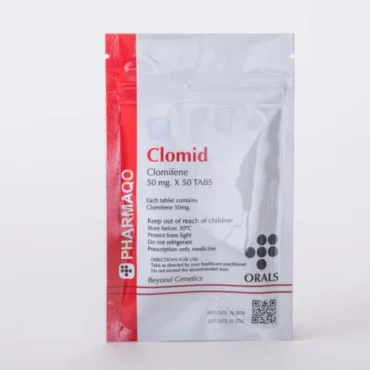

Clomid
Clomid is the brand name for Clomiphene Citrate. It is not an anabolic steroid; it is a Selective Estrogen Receptor Modulator (SERM).
While originally designed to treat female infertility, Clomid is one of the most important drugs in the world of Testosterone Replacement Therapy (TRT) and Post Cycle Therapy (PCT) for anabolic steroid users.
1. Mechanism of Action: The “Trick”
To understand why Clomid is used, you have to understand how it tricks the brain.
- The Problem: When a male uses anabolic steroids, his brain detects high levels of testosterone. Consequently, the brain stops sending signals to the testicles to produce their own testosterone. The testicles shrink (atrophy) and natural production stops.
- The Clomid Solution: Clomid works by blocking (antagonizing) estrogen receptors in the brain (specifically the hypothalamus and pituitary gland).
- The Trick: The brain perceives that there is no estrogen in the body. Since estrogen is a byproduct of testosterone, the brain assumes testosterone levels are also zero.
- The Result: In response to this perceived “low testosterone,” the brain releases a surge of Gonadotropin-Releasing Hormone (GnRH). This tells the pituitary gland to release LH (Luteinizing Hormone) and FSH (Follicle Stimulating Hormone). These hormones travel to the testicles and kickstart them back into action, producing testosterone and sperm.
2. Role in Post Cycle Therapy (PCT)
Clomid is the gold standard for PCT.
When a steroid user finishes a cycle, their natural testosterone is suppressed. If they simply stop the cycle, their natural levels may take months to recover, and during that time, they lose muscle mass, gain fat, and suffer from low libido and depression.
Clomid is taken after the cycle to “restart” the HPTA axis (the communication loop between the brain and testicles) much faster than it would recover naturally.
3. Dosage and Duration
In performance contexts, Clomid is typically dosed higher than it is for female infertility.
- Standard PCT Protocol: Users typically start taking it approximately 2-3 weeks after the last injection of long-ester steroids (or immediately after short-ester/orals).
- Common Dosing:
- Week 1: 50mg per day (sometimes 100mg if shutdown is severe).
- Weeks 2-4: 50mg per day.
- Weeks 5-6: Tapering down or stopping.
- Duration: A typical PCT protocol lasts 4 to 6 weeks.
4. Side Effects
While generally safer than anabolic steroids, Clomid is known for having distinct side effects, particularly related to vision and mood.
- Visual Disturbances: This is the most unique side effect. Some users report blurry vision, seeing “flashes” of light, or having a yellowish tint to their vision. If this occurs, the drug must be stopped immediately to prevent permanent eye damage.
- Emotional Instability: Because Clomid messes with brain chemistry, it can cause significant mood swings, irritability, and depression. It is often jokingly called “Emocid” or “Cryomid” by the fitness community for this reason.
- Estrogen Rebound: Because Clomid blocks estrogen receptors in the brain but doesn’t lower estrogen levels, once the user stops taking Clomid, the high estrogen levels that have built up can suddenly affect the body. This can lead to gynecomastia after the cycle if not managed.
5. Clomid vs. Nolvadex (Tamoxifen)
These two SERMs are often confused, but they have different strengths:
- Clomid: Is generally more potent at stimulating the Pituitary Gland to release LH, making it stronger for restarting testosterone production.
- Nolvadex: Is generally better at blocking estrogen receptors in breast tissue, making it the better choice for preventing or treating gynecomastia.
- Common Practice: In a full PCT protocol, users often take both together to maximize recovery and prevent estrogenic side effects simultaneously.
Summary
Clomid is the “restart button” for the male endocrine system. It blocks estrogen receptors in the brain to force the body to produce its own testosterone. It is an essential component of recovery for anyone ending a steroid cycle, but it requires caution due to its potential to cause vision problems and severe mood swings.
1 review for Clomid
Add a review
Related products
PCT
PCT
oral steroids
Injectable steroids
oral steroids
oral steroids
Injectable steroids

PCT
admin –
“The HCG mixed instantly with the water provided, no clumping at all. The freeze-dried cake looked perfect. Cold shipping ensured it arrived in perfect condition. Great for restarting production.”